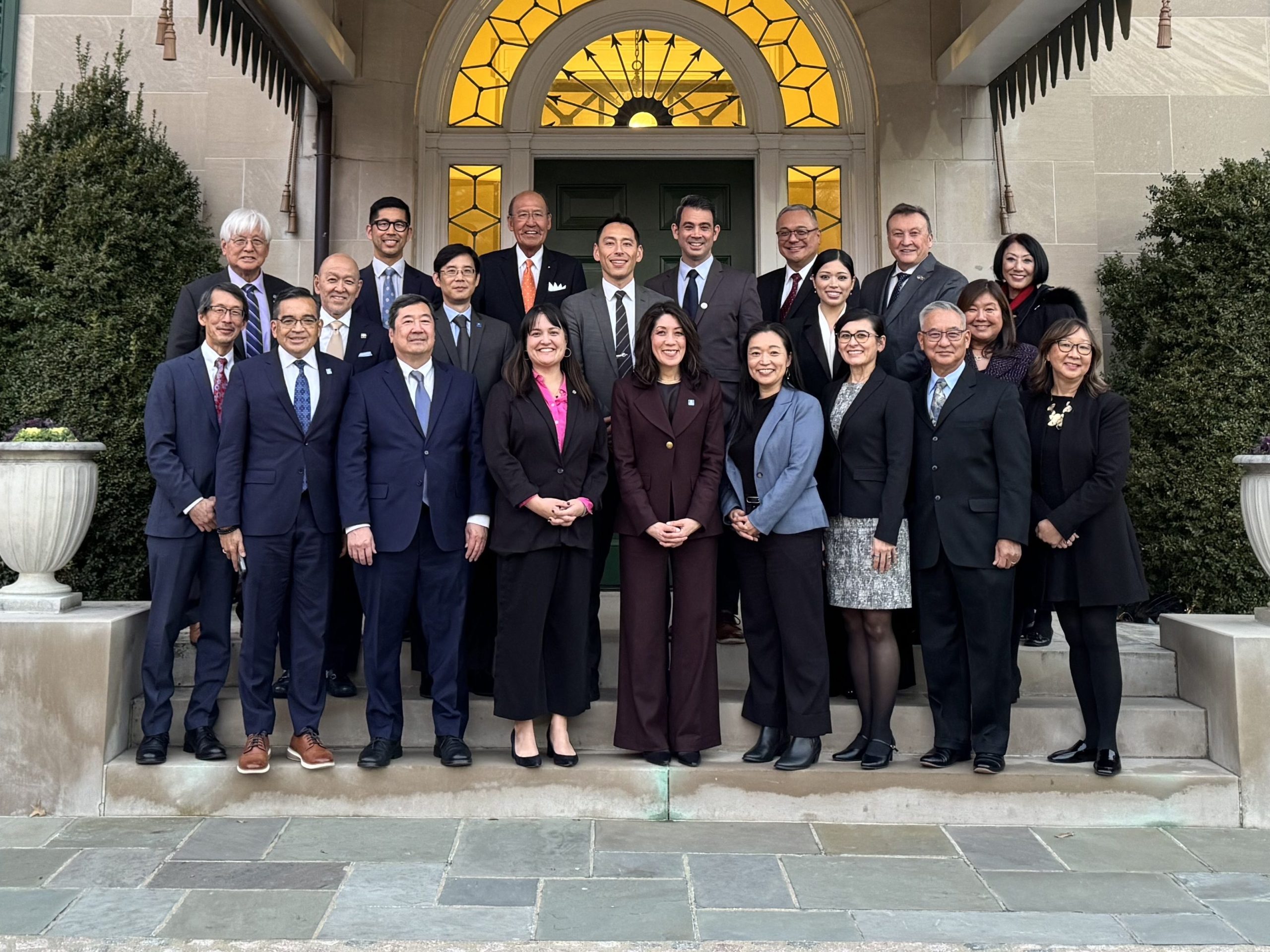
On January 22, prominent Japanese American leaders selected by their respective Japanese Embassy and Consulates across the United States discussed how to strengthen partnership between the Japanese Government and the Japanese American communities at the Japanese Embassy in Washington, D.C.
The meeting is an annual collaborative effort between the Embassy of Japan and the U.S.-Japan Council. The discussion focused on several key topics: challenges that the Japanese American communities face across the United States as well as ideas for collaborations in areas such as nurturing young community leaders for the next generation.
In the evening, Ambassador Japan Shigeo Yamada hosted a reception for the Japanese American leaders, Honorary Consuls and Consuls-General, where he reiterated the importance of the people-to-people relationships in the U.S.-Japan relationship.
U.S.-Japan Relations Through Japanese American Perspectives
Naomi Ostwald Kawamura, Executive Director, Densho and Stephen Toyoda, President, Japanese Culture Center, were two of the Japanese American leaders who were in attendance, representing the Seattle and Chicago Consuls General respectively. They provided the following reflections:
The convening offered an opportunity for Japanese American leaders to share their thoughts through prepared remarks and an hour for discussion. Several themes emerged across the discussion:
- Engaging younger generations of Japanese Americans
- Promotion of cultural heritage and community-based activities
- Sharing programming models and best practices across regions
- Supporting language learning and revitalization
- Growing interest in genealogy and ancestral research
- The importance of strong relationships between Consul Generals and local Japanese American communities
- Preserving and sustaining historical memory
Naomi Kawamura
The Japanese American community serves a unique role within the US Japan relationship. Our history has been shaped by both nations and by the consequences of conflict between them…The next generation of Japanese Americans needs to feel supported in understanding that Japanese American history is not just American history. It is also a history of Japan, a shared history of how culture can survive beyond borders, and how democracies can fail its citizens and how they recover. A shared history between the US and Japan creates shared reference points, grounded in evidence while recognizing diverse perspectives, and helps us to understand consequences. Historical understanding is not separate from diplomacy, it helps shape its foundation.
Looking ahead, Ambassador Yamada expressed his sincere interest in and a commitment to continued dialogue and meaningful collaboration between Japanese American leaders and Japanese government representatives. The convening reinforced the important role Japanese American communities serve as bridges between nations and in shaping a thoughtful, historically grounded approach to building durable and sustaining U.S.-Japan relations.
Stephen Toyoda
- Focus on one point, spread to many points… by simply sharing our personal and community stories and culture, we become living bridges between two vital global partners.
- Sharing the history of Chicago’s ‘lost’ Japantown has sparked interest in installing historical kiosks and planting cherry trees that will greet 100,000 visitors a year.
- When we share experiences with the broader public, we can make a nation halfway across the world feel like a neighbor.
- Many of these projects would not be as successful without the ‘convening power’ of the Consulate to bring crucial leaders to the table who might otherwise be unavailable to the general public.